
Level 4 - Cultivate the Internal Arts (50 hours)
50 hours
Journey further inward.
Level 4 brings together the learning, practices and principles of the previous three levels and takes the journey deeper into the internal arts of Qi Gong and Tai Chi. At this stage, the emphasis is no longer on collecting more movements. Instead, we return to familiar practices with greater sensitivity and explore what is happening beneath the form — structure, breath, intention, connection, relaxation, awareness and Qi. Through Nei Gong, Dan Tian cultivation, advanced Zhan Zhuang, internal breathing, Push Hands and Tai Chi, you’ll explore how the body can become more integrated, responsive and connected from the inside out.
Level 4 is also an opportunity to reflect on your development as a teacher. Technique matters, but teaching the internal arts asks something more of us: patience, humility, curiosity, presence and a willingness to remain a student. The journey does not end with Level 4. In many ways, this is where the deeper practice begins.
What You’ll Explore
The transition from external movement towards internal cultivation
Nei Gong and the internal qualities that support Qi Gong and Tai Chi
The Three Internal Harmonies — harmonizing Xin (heart-mind) with Yi (intention), Yi with Qi, and Qi with Li (power)
Developing whole-body connection rather than moving the body as separate parts
Cultivating Song — releasing unnecessary tension while maintaining structure, awareness and connection
The relationship between relaxation, rooting, structure and internal power
Dan Tian awareness and cultivation as a foundation for integrated movement
How breath, intention and awareness can support internal practice
Refining sensitivity through stillness, movement and partner practice
Exploring the relationship between physical structure, connective tissue and whole-body movement
Returning to familiar Tai Chi movements to experience them through a deeper internal lens
Developing Nei Gong
Nei Gong can be translated simply as “internal skill” or “internal work.” Rather than being a single sequence or technique, it describes qualities that are gradually developed through consistent practice.
Level 4 introduces you to some of these internal qualities through standing, breathing, movement and awareness. You’ll explore how relaxation, alignment, intention, breath and whole-body connection can begin to work together.
The movements may look simple from the outside. The practice is increasingly happening on the inside. Instead of asking:
“Am I doing the movement correctly?”
we begin asking: “What can I feel?”
“Where am I holding unnecessary tension?”
“Am I connected from the ground through the whole body?”
“Can I move with less effort?”
This shift from doing to sensing is at the heart of the internal arts.
Song — Relaxed, but Not Collapsed
One of the central explorations of Level 4 is Song. Often translated as relaxation, Song is more nuanced than simply becoming loose or passive. It is the ability to release unnecessary muscular tension while maintaining structure, connection and awareness.
You’ll explore how greater relaxation can allow the body to become more responsive and integrated. The paradox is important:
Less unnecessary effort can create greater connection.
Softness does not mean weakness.
Structure does not require rigidity.
As Song develops, movement can become quieter, more efficient and more connected.
Dan Tian Cultivation
Level 4 deepens awareness of the lower Dan Tian as an important centre within traditional internal arts practice. Through standing, breathing and movement practices, you’ll explore how attention to the Dan Tian can support grounding, centring and whole-body coordination. Rather than treating the Dan Tian as an abstract concept, we approach it experientially.
Can you feel your centre?
Can movement begin from the centre rather than the limbs?
Can the upper body remain soft while the lower body stays rooted?
These questions become part of an ongoing practice rather than something to master in a weekend.
Tai Chi — Returning with Fresh Eyes
In Level 3, you learned the 24-Form Beijing Yang Tai Chi sequence. In Level 4, we return to the form. But this time, the emphasis changes. Instead of primarily remembering choreography, we use familiar movements as a laboratory for exploring internal principles. You’ll revisit the 24-Form with greater attention to:
Rooting and grounding
Song and release
Dan Tian awareness
Whole-body connection
Weight transfer
Intention and direction
Continuous movement
Yin - Yang within transitions
Moving from the centre
The form may be the same. Your experience of it is not.
Push Hands — Listening Through the Body
Push Hands continues the partner work introduced in Levels 2 and 3.
At Level 4, the practice becomes a deeper exploration of sensitivity, connection and response.
Rather than trying to overpower another person, Push Hands teaches us to listen through touch.
You’ll continue exploring:
Rooting while interacting with another person
Maintaining Song under gentle pressure
Listening through physical contact
Following rather than resisting
Neutralizing incoming force
Recognizing tension in yourself
Maintaining your centre while adapting to change
Using structure and connection rather than unnecessary muscular effort
Push Hands gives immediate feedback. When we become rigid, we feel it. When we lose our root, we notice. When we stop listening, our partner lets us know. In this way, partner practice becomes another teacher.
The Path of the Teacher
By Level 4, you have accumulated many practices, teaching tools and experiences. The question now becomes less about what else you can teach and more about how you teach. You’ll explore:
Teaching from embodied experience
Knowing the difference between what you have learned and what you have genuinely integrated
Staying within the scope of your knowledge and experience
Continuing to practice what you teach
Creating space for students to discover rather than providing every answer
Teaching internal concepts in clear, accessible language
Remaining curious as your understanding evolves
Recognizing that different students may experience Qi Gong differently
Cultivating humility, patience and beginner’s mind
Continuing your own education after certification
A good teacher does not need to demonstrate how much they know.
The practice is often revealed in how they listen, how they respond and how they hold space for others to learn.
Practices
Your Level 4 practice toolkit includes:
Internal Qi Gong — Nei Gong Fundamentals
Advanced Zhan Zhuang
Dan Tian cultivation
Internal breathing practices
Bone and fascia strengthening exercises
24-Form Beijing Yang Tai Chi — revisiting the form through internal principles
Push Hands — deeper listening, following, neutralizing and connection
Traditional Weapons — Introduction
Traditional Weapons — Introduction
Traditional weapons practice offers another way to explore extension, coordination, intention and whole-body connection. Rather than approaching the weapon simply as an object held in the hand, we begin exploring how it can become an extension of the body.
This introductory practice offers a glimpse into another dimension of the traditional internal arts while reinforcing principles already explored throughout the training: rooting, centre, intention, connection and fluid movement.
Cultivate → Integrate → Share
Level 4 is not about reaching the end. It is about integrating what you have learned.
Level 1 gave you the foundations. Level 2 invited you to relax, root, connect and cultivate. Level 3 asked you to embody the practice and carry it into everyday life. Level 4 brings you back inward — refining the internal qualities that have quietly been present throughout the entire journey.
CULTIVATE → INTEGRATE → SHARE
Continue practicing. Continue questioning. Continue listening. Continue learning. The movements will become familiar. Your understanding of them will continue to change. The deepest measure of the practice is ultimately not how many forms you know, how much Qi you can feel, or how impressive your movements appear. It is how the practice shapes the way you move through the world. The four levels complete your 200-hour Qi Gong Teacher Training journey. But they do not complete your Qi Gong practice. They give you a foundation from which to continue.
About the Lead Teacher, Hang Nhan
Qi Gong Educator • Teacher Trainer • Co-Founder of saigon om
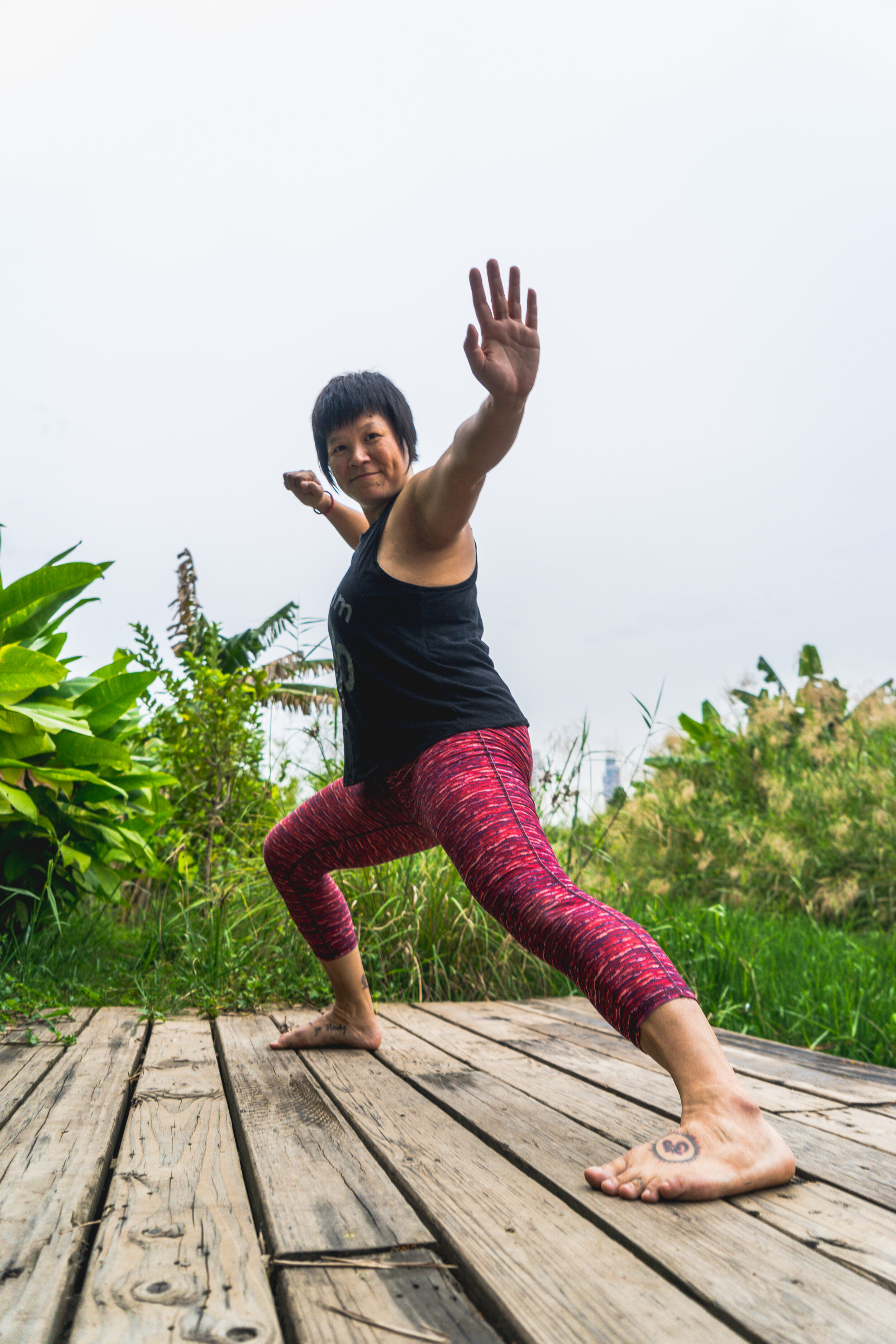
Hang’s path to Qi Gong began through more than 20 years of martial arts, movement and teaching. Her early years were spent training and competing in external martial arts, including Taekwondo, Brazilian Jiu-Jitsu, Judo, Kung Fu and Kali. After years of pushing her body — and accumulating injuries along the way — she began looking for a more sustainable way to cultivate strength, health and longevity.
That search led her to Qi Gong and Yang Tai Chi, first in Canada and later in southern China, where she spent two years from 2006–2008 deepening her study of the internal arts at the root school of Choy Li Fut.
Today, Hang’s work brings together traditional Qi Gong, Traditional Chinese Medicine (TCM), mindfulness and movement science. She is particularly interested in helping students understand the why behind the practice — how Qi moves through the body, how TCM views the relationship between the organs, emotions and energy, and how Qi Gong can help harmonize these patterns and bring the body-mind back towards balance.
Her ongoing studies include Five Element Acupressure, alongside years of exploration in anatomy, biomechanics, fascia, injury prevention and mindful movement.
A former engineer, school teacher, personal trainer and martial arts instructor, Hang brings an educator’s curiosity to everything she teaches. Her approach is practical, inclusive and down-to-earth: learn the movements, understand the principles, feel them in your own body, and discover how the practice can become part of everyday life.
Through saigon om, Hang now focuses primarily on Qi Gong education and Teacher Training Levels 1–4, supporting practitioners and wellness professionals who want to move beyond simply following Qi Gong movements towards a deeper understanding of the practice.
And when she’s not chasing after two rambunctious children, Hang can usually be found stealing little pockets of quiet to work on her first Qi Gong book — a project that, much like Qi Gong itself, is teaching her something about patience, persistence and going with the flow.